Ludwigshafen / Mannheim, 21 February 2025
Ports of Ludwigshafen and Mannheim Record Total Waterborne Cargo Throughput of 11.3 million Tons in 2024
Inland vessels reduce road traffic by approx. 3,100 trucks per day
The ports of Ludwigshafen and Mannheim look back on a mixed financial year in 2024: a total of 11,281,601 tons of cargo were handled via waterways, of which 5.5 million tons in Ludwigshafen and 5.8 million tons in Mannheim. A total of 1,425,271 tons were handled in container traffic, including 735,269 tons in Ludwigshafen and 732,386 tons in Mannheim.
“Current figures are significantly shaped by a strong decline in coal transshipment, a trend that is expected to continue in the coming years. In addition, tonnages in the categories of stones and earth as well as food and feed declined. Traffic volumes in the Port of Mannheim remain stable. The most significant increase was recorded in chemical products. This demonstrates that inland ports offer an attractive and environmentally friendly logistics solution for the economy in the Rhine-Neckar metropolitan region. The modal shift of freight transport from road to inland waterways and rail has been successfully practiced for decades and represents an important lever for achieving climate targets in the transport sector. Inland ports therefore stand for employment, regional production, trade, and the reliable supply of goods and energy to citizens,” said Uwe Köhn, Director of the Port of Mannheim, on Friday, 21 February 2025.
“To achieve ambitious climate targets, the EU implemented new directives on European emissions trading in June 2023. For their implementation, the German Bundestag adopted amendments to the Greenhouse Gas Emissions Trading Act on 31 January 2025, which are expected to enter into force at the end of March. As a result, emissions trading will be extended to the transport sector from 2027, and prices for emission certificates are expected to rise. Despite current economically driven declines in volumes, our port locations will therefore gain significantly in importance for achieving climate targets. They enable the transport of goods by inland vessel and rail transport modes that emit only a fraction of the energy consumption and pollutants per tonne compared to trucks. Thus, ports not only relieve our road infrastructure but are also a decisive location factor for companies in the region,” said Alexander Voigt, Managing Director of Häfen Rheinland-Pfalz GmbH.
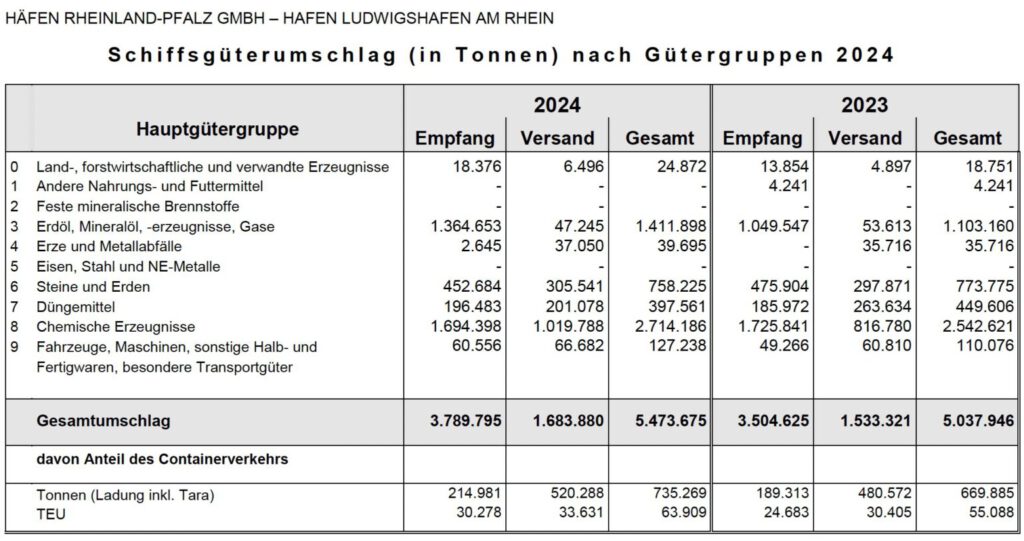
Waterborne cargo throughput in the Port of Ludwigshafen increased by 435,729 tons, rising from 5,037,946 tons to 5,473,675 tons (+8.65%). In contrast, waterborne cargo throughput in the ports of Mannheim decreased by 505,864 tons (–8.01%), from 6,313,790 tons to 5,807,926 tons.
Container handling volumes in Ludwigshafen declined by 17,086 tons to 735,269 tons, representing a decrease of 2.27% compared to the previous year. In the Mannheim ports, container volumes declined by 3.09%, from 755,386 tons to 732,012 tons.
The composition of cargo groups depends strongly on the companies located within each port and therefore varies considerably:
- In Ludwigshafen, chemical products account for the largest share of throughput, followed by petroleum, mineral oil products and gases. The third-largest cargo group is stones and earth.
- In Mannheim, the highest waterborne throughput is recorded in the category of food and feed, followed by solid mineral fuels and chemical products.
In Ludwigshafen, the development of cargo groups compared to the previous year was as follows:
- Chemical products increased by 171,565 tons to 2,714,186 tons (+6.75%)
- Petroleum, mineral oil products and gases rose from 1,103,160 tons to 1,411,898 tons (+27.99%)
- Stones and earth declined by 15,550 tons to 758,225 tons (–2.01%)
In Mannheim, increases were recorded in four cargo groups:
- Chemical products: +18.17% (+112,470 tons)
- Agricultural and forestry products: +5.39% (+6,751 tons)
- Petroleum, mineral oil products and gases: +5.35% (+24,300 tons)
- Ores and metal scrap: +1.16% (+5,489 tons)
The most significant declines in Mannheim were observed in:
- Stones and earth: –23.49% (–134,966 tons)
- Solid mineral fuels: –18.31% (–259,929 tons)
- Other food and feed: –9.10% (–165,684 tons)
By transporting goods via inland waterways, the ports actively contribute to reducing truck traffic and thereby lowering noise levels and harmful emissions. Overall, the ports relieved roads and bridges in the urban areas by approximately 3,100 trucks per day, based on an average load of around 10 tons per truck.
A comprehensive overview can be found in the attached documents, including comparative figures.