Ludwigshafen / Mannheim, 18. February 2026
The ports of Ludwigshafen and Mannheim record total waterborne cargo throughput of 11.8 million tons in 2025
Inland vessels reduce road traffic by approximately 3,300 trucks per day
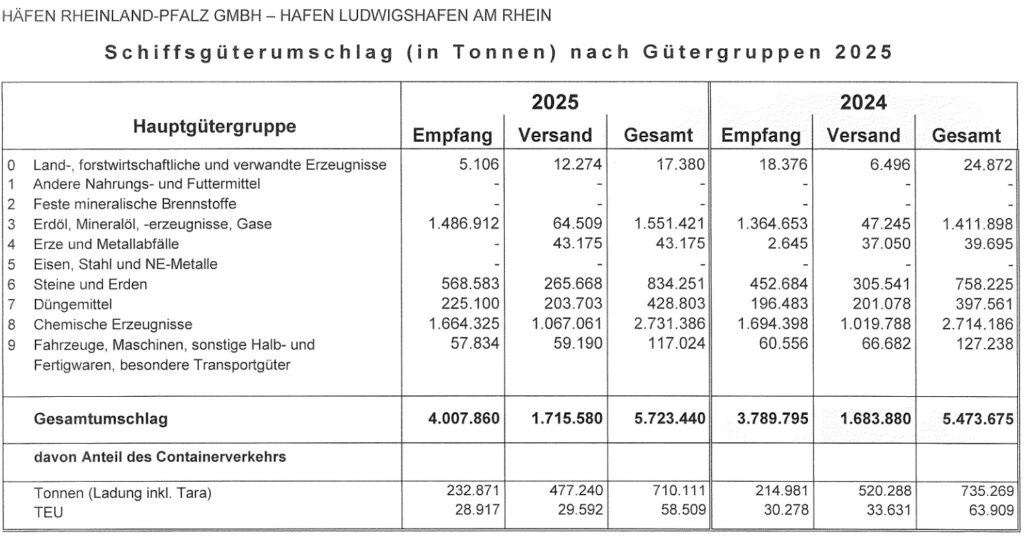
The ports of Ludwigshafen and Mannheim look back on a slightly improved financial year in 2025: a total of 11,828,997 tons of cargo were handled via inland waterways, including 5.7 million tons in Ludwigshafen and 6.1 million tons in Mannheim. Waterborne container throughput amounted to 1,410,608 tons, of which 710,111 tons were handled in Ludwigshafen and 700,497 tons in Mannheim.
“With a total throughput of over 6 million tons and positive growth of 5.12 percent compared to the previous year, 2025 has been a pleasing year for the State Port of Mannheim,” said Uwe Köhn, Director of the Port of Mannheim, on Monday, 16 February 2026. “However, inland ports stand for more than just high transport volumes. Their significant economic importance lies in the value creation and employment they generate among their customers and within the shipping and logistics industry. The ports contribute to the secure supply of goods and energy for citizens.”
Waterborne cargo throughput in the Port of Ludwigshafen increased by 249,765 tons, from 5,473,675 tons to 5,723,440 tons (+4.56%). In Mannheim, throughput rose by 297,631 tons (+5.12%), from 5,807,926 tons to 6,105,557 tons.
Container handling volumes declined in both ports. In Ludwigshafen, container throughput fell by 25,158 tons to 710,111 tons (–3.42%). In Mannheim, volumes decreased by 4.31%, from 732,012 tons to 700,497 tons.
The distribution of cargo groups varies significantly depending on the industries located at each port. In Ludwigshafen, chemical products account for the largest share of throughput, followed by petroleum, mineral oil products, and gases, with stones and earth materials ranking third. In Mannheim, the highest volumes are recorded in other food and animal feed products, followed by solid mineral fuels and chemical products.
Within individual cargo groups, developments in Ludwigshafen compared to the previous year were as follows:
- Chemical products increased by 17,200 tons to 2,731,386 tons (+0.63%)
- Petroleum, mineral oil products, and gases rose from 1,411,898 tons to 1,551,421 tons (+9.88%)
- Stones and earth materials increased by 76,026 tons to 834,251 tons (+10.03%)
In Mannheim, increases were recorded in the following cargo groups:
- Solid mineral fuels (+37.40%, +433,824 tons)
- Other food and animal feed products (+1.20%, +19,799 tons)
- Iron, steel, and non-ferrous metals (+0.93%, +2,074 tons)
Declines were observed particularly in:
- Agricultural, forestry, and other products (–11.96%, –15,787 tons)
- Chemical products (–8.26%, –60,378 tons)
- Ores and metal waste (–6.89%, –33,108 tons)
By transporting goods via inland waterways, the ports actively help reduce truck traffic and thereby decrease noise and harmful emissions. Overall, the ports relieved roads and bridges in the urban areas by approximately 3,300 trucks per day, assuming an average load of around 10 tons per truck.
Given the strained state of road infrastructure in the region, inland waterways play a key role. Alexander Voigt, Managing Director of Häfen Rheinland-Pfalz GmbH, emphasized this relieving function:
“We, as port locations – as well as the entire economy – are affected by the limited usability of regional bridges. However, especially in this situation, the functionality of the ports is of crucial importance, as they significantly ease the transport system. Without the capacities of the ports and the modal shift to water and rail, the situation for businesses and people in the region would be much more challenging.”
In 2026, the ports will continue to invest in the maintenance and modernization of port infrastructure, digitalization, and climate adaptation measures.
For the current year, the ports expect moderate stabilization, provided that industrial activity gradually recovers and international supply chains continue to normalize. However, the market environment is expected to remain volatile.
A comprehensive overview can be found in the attached documents, including comparative figures.