
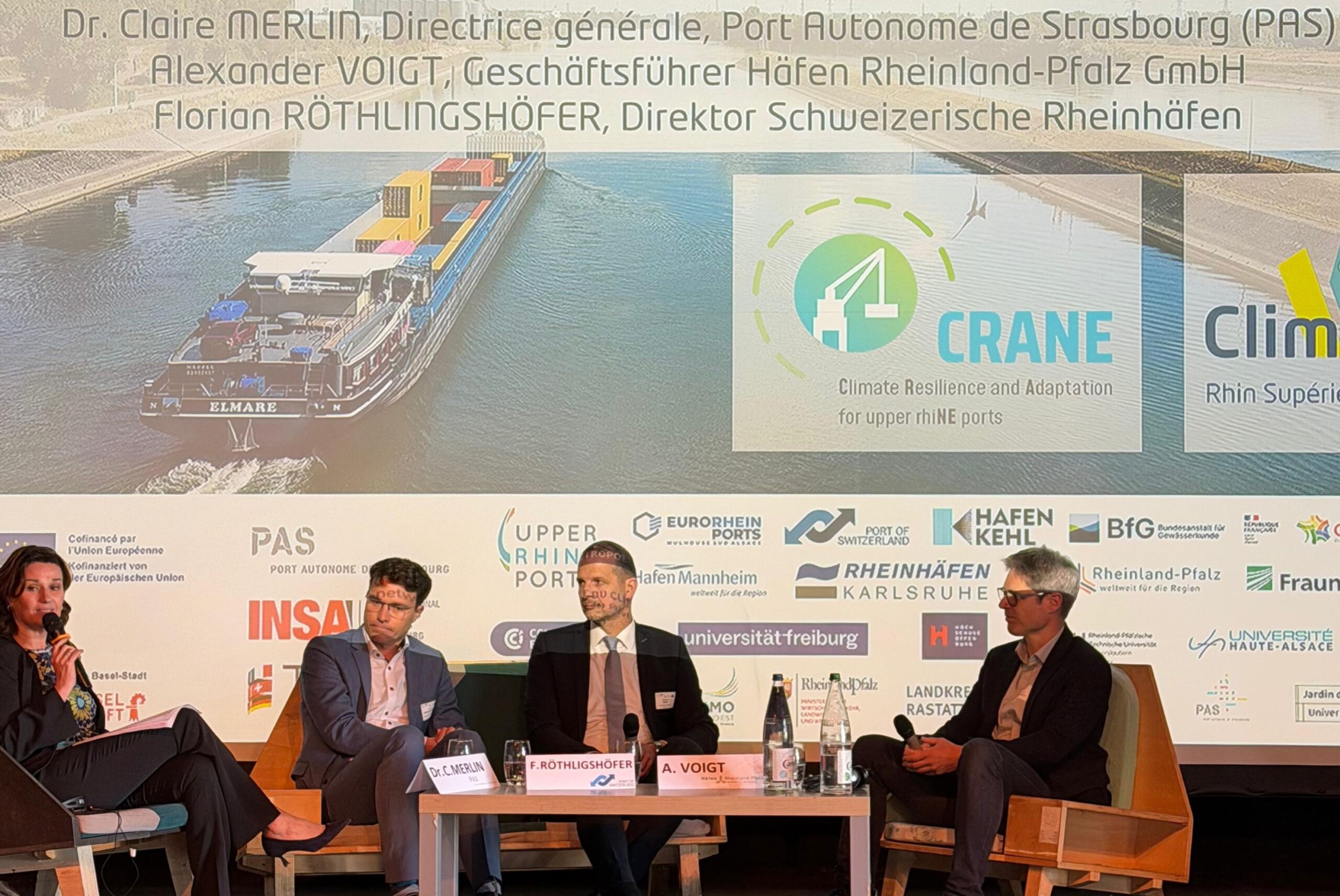
Final Colloquium of the CRANE and Clim’Ability Care Projects
Strasbourg, 27 April 2026
In collaboration with INSA Strasbourg and Trion-climate e.V., the Port of Strasbourg organized the final colloquium of the Interreg projects CRANE and Clim’Ability Care on 27 April 2026. Both projects are dedicated to climate adaptation and the resilience of ports and inland navigation. The event brought together representatives from ports, scientific experts, and public stakeholders and conveyed a central message:
Ports already have concrete solutions, a shared momentum for adaptation has been initiated, and the Rhine remains a transport corridor with a future.
The CRANE project, coordinated by the Port of Strasbourg, concludes after three years of intensive cooperation within a consortium comprising:
- seven Upper Rhine ports – Strasbourg, Kehl, Karlsruhe, Mannheim, Ludwigshafen, Mulhouse, and Basel,
- French and German expert institutions specializing in climate risks and resilience – Cerema and Fraunhofer IAIS, and
- associated partners – BfG, INSA, and DREAL Grand Est.
The project had a total budget of EUR 1.4 million, co-financed at 60% by the Interreg Upper Rhine Programme, the Swiss Confederation, and the Cantons of Basel-Stadt and Basel-Landschaft.
The project aimed to analyse the impacts of climate change on port operations and infrastructure and to develop practical, immediately implementable adaptation measures for ports.
The analyses focused on the key climate-related hazards affecting Upper Rhine ports: heatwaves, drought periods, heavy precipitation, storms, and flooding, as well as the hydrological development of the Rhine, with particular emphasis on low-water periods, which are of critical importance for inland navigation. The applied methodology combines the analysis of past damage events with climatic and hydrological projections up to 2060 and 2100, urban heat island effects, and extreme event scenarios. This approach was complemented by a series of eleven workshops involving around 30 engineers and technicians from the ports.
The findings show that certain critical infrastructures, such as energy and telecommunications networks, exhibit comparatively low vulnerability, while other components are more significantly affected. These include port rail infrastructure, transshipment areas, road infrastructure, outdoor personnel, and at a higher level the Rhine itself, whose navigability depends on available water levels.
On this basis, nearly 500 adaptation measures were assessed and prioritized. The most relevant measures include, in particular, the introduction of crisis and business continuity plans, enhanced maintenance and investment in more resilient infrastructure, the integration of adaptation measures already at the project planning stage, measures for greening and soil de-sealing, the expansion of rail capacities to facilitate modal shift during low-water periods, and coordination with various stakeholders, ranging from river and rail network operators to local authorities.
Today’s colloquium presented these results as part of a morning program dedicated to the CRANE and Clim’Ability Care projects. Scientific contributions from Fraunhofer IAIS and Cerema were followed by a high-level panel discussion on findings, possible courses of action, and the importance of cross-border cooperation. In the afternoon, site visits to the ports of Strasbourg and Kehl are scheduled.
Beyond the conclusion of the project, the ports now have concrete tools and trained staff to actively implement their adaptation pathways.
The CRANE project is part of a long-standing cooperation among Upper Rhine Ports, which has been operating for more than ten years under the name Upper Rhine Ports. The focus lies on shared challenges such as the competitiveness of ports and multimodal transport, the decarbonization of the economy and logistics, and the strengthening of resilience. This European cooperation makes a significant contribution to the economic dynamism of the Upper Rhine region and reinforces the structuring role of ports in territorial development.
Press contakt:
Tel.: 03.88.21.74.13 / pas@strasbourg.port.fr